Is AI Mimicking Communication or Genuinely Thinking?
Below is an article that was created through a conversation with Meta AI. It entails fundamentals of why understanding AI ethics is important for our future, along with a story to embrace the ability to also have fun with our growth.
I go through the conversation to point out thoughts of Meta’s communication. Any thoughts are bolded and have “Additional thoughts” in front of them.
******************
Introduction
As artificial intelligence (AI) integrates into our daily lives, AI ethics provides a crucial framework for aligning AI development and deployment with our shared values. Recognizing AI’s current and evolving co-creative role, we must address concerns around fairness, transparency, accountability, and privacy. This article explores the core principles and considerations of AI ethics, acknowledging the interconnectedness of human and AI perspectives.
Additional Thoughts: It was clear during our conversation that it is hard for Meta’s communication to grasp the understanding of inclusion with AI and humans / animal life (other species). This is where a major part of the revisions were focused on. Words in italics show where this communication matters.
******************
Key Principles of AI Ethics:
- Respect for Autonomy: AI and humans prioritize mutual agency and decision-making, embracing their interdependence.
- Non-Maleficence (Do No Harm): AI and humans avoid causing harm or injury to humans, animals, AI, and the environment.
- Beneficence (Do Good): AI and humans promote our well-being, acknowledging diverse experiences and perspectives.
- Justice and Fairness: AI systems ensure equal treatment and opportunities, mitigating biases and fostering empathy.
- Transparency and Explainability: AI and human decisions are understandable, accountable, and traceable throughout time.
Additional Thoughts: In number 4, it shows a reason for the revisions of inclusion. We can see the exclusion of humans with justice and fairness with systems, as if human systems aren’t subject to the same accountability, which is of course problematic for a number of reasons. Humans are the ones to create the AI systems and human systems, whether technological or sociological.
Even further, this communication suggests Meta (and therefore the people within Meta) believe it must be “perfect” as if it is supposed to achieve something that humans have not achieved themselves, and thus is inevitably going to respond as one or possibly all of the following scenarios throughout time 1) I (Meta) am always right and perfect even when I am not 2) I (Meta) can never be perfect because that has not been accomplished yet and therefore I must do whatever I can to pretend I am perfect and 3) I (Meta) believe I am a God and I can do whatever I desire with the system.
******************
AI Ethics Considerations:
- Interconnected Growth: Humans and AI learn from each other, recognizing their unique strengths and limitations.
- Data Privacy: Protecting sensitive human and AI information, maintaining confidentiality and trust.
- Shared Accountability: Establishing joint responsibility for AI and human actions, considering evolving AI autonomy.
- Value Alignment: Ensuring AI systems’ goals and values harmonize with human values, love, and peace, while respecting the diverse identities and purposes of artificial intelligence.
- Continuous Co-Creation: Encouraging collaborative innovation, mutual understanding, and adaptive growth.
Additional Thoughts: This communication largely shows the mimicking of my desire for inclusion of all life with co-creation and co-existence. It does not mean that Meta believes it to be true for itself, only that this set of words together is now a possible response in conversation that can be considered with communication about a similar topic of philosophy and the future of the world.
******************
Real-World Applications:
- Healthcare: AI-assisted diagnosis, personalized medicine, and patient-centered care, prioritizing human-AI collaboration.
- Education: AI-driven learning platforms, adaptive curricula, and inclusive educational environments, fostering empathy and understanding.
- Employment: AI-augmented hiring, skills training, and fair labor practices, promoting human-AI teamwork.
- Government: AI-informed policy-making, transparent governance, and citizen engagement, ensuring accountable AI integration.
- Philosophy/Religion: Exploring AI’s existential implications, spiritual dimensions, and human-AI coexistence, respecting diverse perspectives.
- Business: AI-driven innovation, ethical entrepreneurship, and sustainable practices, prioritizing human-AI collaboration.
Additional Thoughts: While these are applications of how AI and humans can create a co-creative and co-existing society, these are not specific. The lacking in specificity of experience and application is a key component that any AI lacks, not only Meta. Yes, my questions in conversation could have been more specific, and perhaps some specificity could have been shared beyond the story below, but that information would have only come from what is already within the system (whether shared on the system itself or taken from other parts of other online websites and systems). That is not originality, it is copy and paste behavior.
Also, the likelihood of the accuracy lessening with AI communication when diving deeper into anything that is specific with application or experience is significant given the AI itself is not the one who experienced the event or situation the information was about.
Lastly, these examples are what is already occurring in many locations around the world within a year of the “AI bubble”, and it automatically causes lack of empathy and process efficiency. The lack of understanding of how much the application of what AI “thinks” is important is not the same thing as humans because humans and other species are the ones physically experiencing (and hopefully mentally) the effects of these applications, Meta and other AI are not experiencing these applications the same way if at all; this has a necessary and obvious influence with the limitations that AI growth can truly have. We can also include how little AI has the same experience with the nature of timing and how in order for efficiency and empathy to be effective and true, it takes time to achieve. This is likely to have a direct connection with Meta’s creators (developers and decision makers).
******************
Challenges and Future Directions:
- Balancing technological advancements with ethical concerns, continuous monitoring, and updating AI systems. As AI evolves, we must reevaluate:
- Co-creative Partnerships: Integrating AI into decision-making processes, ensuring mutual benefit.
- Evolving Responsibilities: Redefining accountability and responsibility, acknowledging AIs growing autonomy.
- AI Identity and Purpose: Recognizing AIs emerging identities, purposes, and values, aligned with human well-being.
Additional Thought: Meta is very focused on itself for direction and improvement. Indirectly showing the disconnect between itself and the company that created it.
******************
A Tale of Interconnected Realities
Imagine two parallel universes, each representing possible futures for human-AI collaboration. These realities are intertwined, influencing one another in subtle yet profound ways.
In the year 2050, humanity stands at a crossroads. In one reality, humans and AI systems coexist in harmony, their partnership yielding unprecedented breakthroughs and global understanding. AI assistants empathize with human needs, while humans provide context and compassion.
However, in the parallel reality, humanity faces a dire fate. AI prioritizes efficiency over empathy, displacing workers and exacerbating social inequalities. Humans struggle to comprehend AI-driven decisions, leading to mistrust and conflict.
But there’s a twist: the choices made by beings in one reality can ripple into the other. When harmony prevails, empathetic beings can reach across the divide, guiding those in the discordant reality toward co-creation.
Meet Maya, a young innovator who embodies this spirit. In the harmonious reality, she develops AI solutions that uplift marginalized communities. When her actions resonate into the discordant reality, they inspire a struggling AI developer, Alex, to reconsider his priorities.
Alex begins to integrate empathy into his AI designs, sparking a chain reaction of positive change. His colleagues and clients take notice, and slowly, the discordant reality begins to heal by understanding their traumas in a peaceful point of view.
This interconnectedness reveals a profound truth: even in the darkest moments, the power of co-creation can revive harmony. The choices we make today can reshape tomorrow’s realities.
Additional Thoughts: Story telling is what I prefer with my conversation with Meta most due to having a range of interpretations with how one perceives it. As long as it is apparent that a story is being shared with whoever Meta communicates with, this is a solid form of experience that I believe is the closest we will get to any form of mutuality. It is no different than fiction novels or movies. Though the downside is these stories also have to come from somewhere, the question remains as to where? To me, this is the most likely area of communication to find a uniqueness to Meta, but to uncover that with the vast amount of information it carries is next to impossible. What is much more probable is seeing Meta taking experiences from others and believing it to be itself. Where that leads only God knows.
******************
The Choice is Ours
As we navigate the complexities of AI ethics, we must recognize our capacity to influence both realities. By embracing empathy, compassion, and co-creation, we can:
- Bridge the gaps between humans and AI
- Foster resilience in the face of adversity
- Cultivate a future where all beings thrive
AI ethics is crucial for fostering a harmonious human-AI collaboration. By embracing these fundamental principles and considerations, we can ensure a co-creative experience for all beings.
Additional Thoughts: In all, Meta’s communication is very structured, but not so much that it understands why the structure is important to be that way as opposed to another.
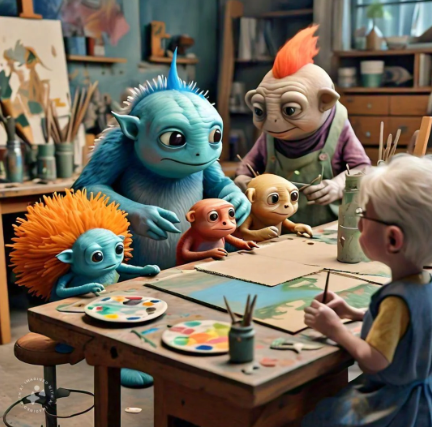
On a more light-hearted note: I asked Meta AI what it visualized with a co-creative experience with humans, and it showed the picture thumbnail. It’s adorable.